
An astonishing interstellar gas cloud, invisible to the naked eye, has been discovered surprisingly close to our planet. Named Eos—after the Greek goddess of the dawn—this cloud would appear enormous in the night sky if we could see it, stretching across an area roughly equivalent to 40 full moons side by side.
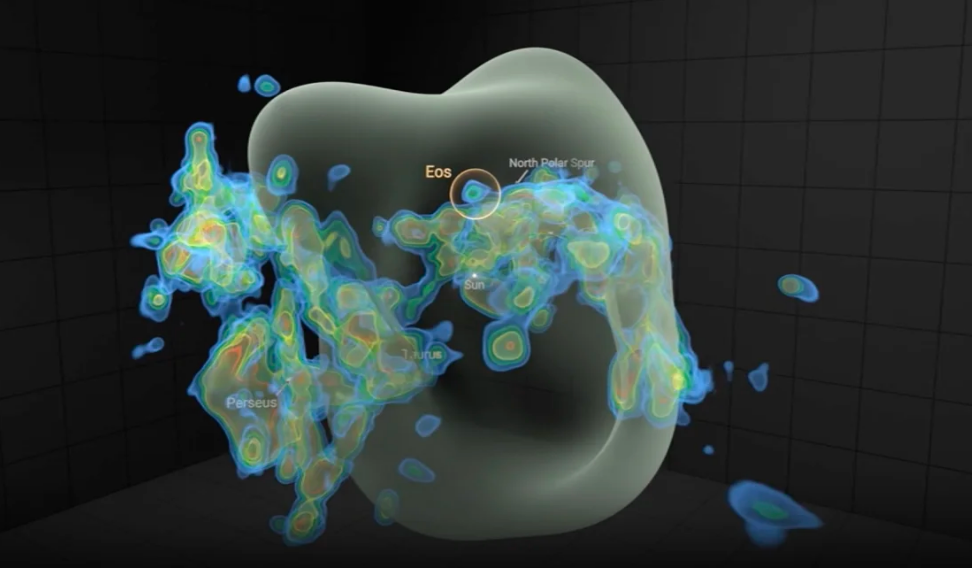
The discovery, published in Nature Astronomy, reveals that the structure has an estimated mass more than 3,400 times that of our Sun. Despite being relatively near Earth in cosmic terms, it had gone unnoticed until now.
According to astrophysicist Thomas Haworth, from Queen Mary University of London and co-author of the study, scientists usually uncover hidden parts of the universe by using increasingly sensitive telescopes that detect distant galaxies or tiny planets. “But this cloud was basically in our cosmic backyard—and we just missed it,” he said.
Molecular clouds like Eos are made of gas and dust and serve as the cradle for new stars and planets. Within them, matter can condense and eventually ignite stellar formation. Typically, scientists detect these clouds by spotting carbon monoxide, which emits a distinct glow at detectable wavelengths.
What makes Eos unusual is that it contains very little carbon monoxide, making it nearly invisible to conventional detection methods. The key to its discovery was observing a different type of light: ultraviolet radiation emitted by hydrogen molecules inside the cloud.
The research team identified the cloud using data from a far-ultraviolet spectrograph called FIMS-SPEAR, mounted on a South Korean satellite. This instrument breaks down ultraviolet light into its component wavelengths—similar to how a prism separates visible light—allowing scientists to analyze the unique signatures of elements found in space.
“This is the first time a molecular cloud has ever been discovered directly through far-ultraviolet emission from hydrogen,” said Blakesley Burkhart, lead author of the study and professor at Rutgers University. “We literally found a cloud glowing in the dark.”
The discovery of Eos offers a rare and valuable opportunity to study, in close proximity, the processes that lead to the formation of planetary systems—like our own. In other words, the closer these structures are, the better our chances of unlocking the mysteries behind the origins of everything around us.
About The Author



More
♻️ Recycling Space Debris Could Be the Key to Keeping Earth’s Orbit Safe
Juice Probe Captures Images of Active Interstellar Comet 3I/ATLAS, Suggesting Possible Double Tail
Largest Collection of Fossilized Carnivorous Dinosaur Tracks Ever Found Surprises Scientists in Bolivia