
Imagine witnessing a colossal explosion in the Universe unlike anything ever recorded before. That’s exactly what happened in 2018, when Earth-based telescopes detected a truly unusual cosmic event approximately 200 million light-years away.
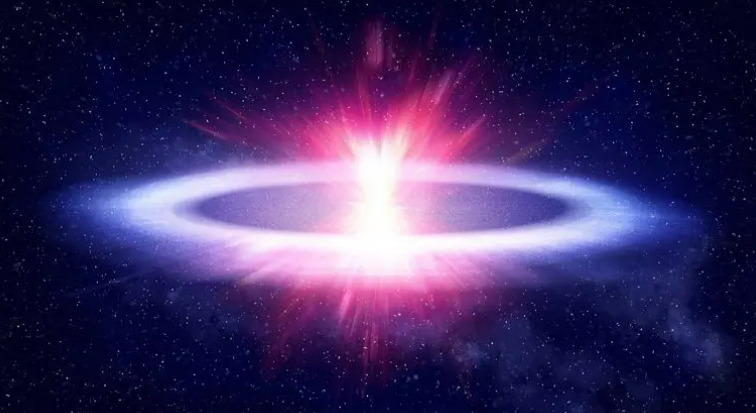
This phenomenon shone with an unexpected brightness and faded just as quickly — far more intense than a typical supernova. Its strange behavior and rapid disappearance caught astronomers off guard. The explosion was so curious that it was named AT2018cow, soon earning the nickname “The Cow.”
Since that dazzling event, similar explosions have been observed across the cosmos. Scientists have labeled them Fast Blue Optical Transients, or LFBOTs for short. These events share key features: extreme brightness, high temperatures, and brief lifespans.
According to astronomer Anna Ho from Cornell University (USA), the “L” in LFBOT comes from their luminosity, while the “blue” part refers to the incredibly high temperature — around 40,000°C — which shifts the emitted light into the blue range of the spectrum. The “O” and “T” refer to the fact that these are optical transients, meaning they appear in the visible spectrum and fade quickly.
At first, scientists theorized that these might be failed supernovae — stars that attempted to explode but instead collapsed into black holes, consuming themselves from the inside out.
However, a new and increasingly favored theory suggests that these mysterious blasts could be triggered when intermediate-mass black holes — a hypothetical type of black hole — swallow nearby stars that drift too close.
A study published in November 2024 presented new evidence supporting this idea. According to astronomer Daniel Perley of Liverpool John Moores University (UK), the scientific community is gradually leaning toward this explanation.
If confirmed, this theory could finally provide solid proof for the existence of intermediate-mass black holes — the missing link between small stellar black holes and the supermassive ones found at the centers of galaxies. It might also offer vital clues in the ongoing quest to understand one of the Universe’s greatest mysteries: dark matter.
About The Author


More
♻️ Recycling Space Debris Could Be the Key to Keeping Earth’s Orbit Safe
Juice Probe Captures Images of Active Interstellar Comet 3I/ATLAS, Suggesting Possible Double Tail
Largest Collection of Fossilized Carnivorous Dinosaur Tracks Ever Found Surprises Scientists in Bolivia