
A team of deep-sea divers has successfully retrieved the first objects from the HMHS Britannic, known as the “Titanic’s sister ship,” which sank near the Greek island of Kea in 1916. The discovery was announced by the Greek Ministry of Culture.
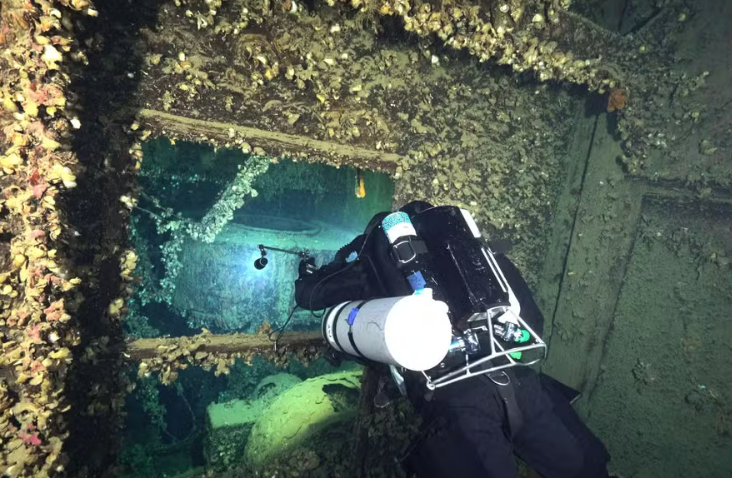
The ocean liner rests at around 120 meters deep, and even after more than a hundred years underwater, it preserved historic items such as the ship’s alarm bell, a signaling lamp, objects from first- and second-class cabins, ceramic tiles from a Turkish bath (similar to a sauna), and even a pair of binoculars used at the time.
Built at the Harland & Wolff shipyard, the Britannic was part of the same series of transatlantic liners as the Titanic and the Olympic. During World War I, it was requisitioned by the Royal Navy and converted into a hospital ship. In November 1916, it struck a German naval mine and sank in less than an hour. Of the 1,065 people on board, only 30 lost their lives.
The recovery mission involved eleven specialized divers, along with scientists and researchers, led by British historian Simon Mills of the Britannic Foundation, under the supervision of the Greek Ephorate of Underwater Antiquities. The work was far from easy, as strong currents, poor visibility, and the depth posed major challenges.
Some artifacts remain on-site due to difficult access or fragile condition. The recovered pieces were taken to conservation laboratories in Greece and will eventually be displayed in a permanent exhibition at the new Museum of Underwater Antiquities, currently under construction at the port of Piraeus, near Athens.
About The Author



More
♻️ Recycling Space Debris Could Be the Key to Keeping Earth’s Orbit Safe
Juice Probe Captures Images of Active Interstellar Comet 3I/ATLAS, Suggesting Possible Double Tail
Largest Collection of Fossilized Carnivorous Dinosaur Tracks Ever Found Surprises Scientists in Bolivia