
Space around our planet is becoming increasingly crowded — and not with spaceships. The growing amount of debris orbiting Earth has already turned into a global challenge. Pieces of inactive satellites, fragments of rockets, and even tiny particles of paint together create a real threat to space missions and to the communication systems we rely on every day.
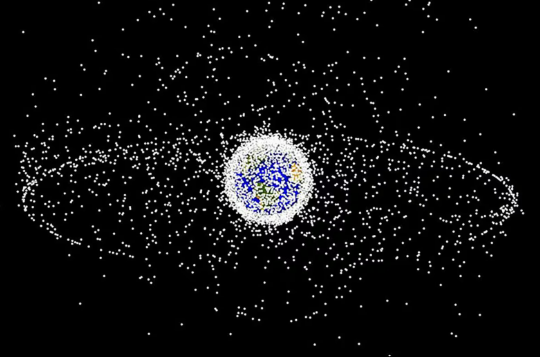
Currently, there are millions of fragments circling our planet. According to international space agencies, more than 25,000 objects are large enough to be constantly monitored. Altogether, this debris weighs over 9,000 tons.
🌍 Sustainable ideas for a growing problem
A team from the University of Surrey in the United Kingdom recently presented an innovative proposal: applying the same environmental principle we use here on Earth — reduce, reuse, and recycle — to outer space.
But this time, with satellites.
According to the researchers, developing equipment to remove debris is not enough. Proper planning is needed from the start, designing satellites that:
✔ can be upgraded or refueled while in orbit
✔ are easy to dismantle so parts can be reused
✔ are created to safely disintegrate at the end of their mission
They also advocate the creation of orbital structures capable of repairing or repurposing materials that are currently just floating around with no use.
🚨 The risk of the “Kessler Syndrome”
The more objects orbit Earth, the higher the danger of collisions. And a single crash can generate thousands of new fragments. There is a real fear that this could cause a domino effect, making part of low Earth orbit completely unusable — a scenario known as Kessler Syndrome.
Losing essential satellites could affect GPS, internet, communication, climate monitoring, and even maritime and air operations. Studies suggest the global economic impact would be massive.
🚀 Technology is advancing — but cooperation is still lacking
Some initiatives are already underway:
• reusable rockets, like those from SpaceX
• robotic arms capable of capturing useless objects
• software that can redirect satellites to avoid collisions
However, global coordination is still missing. International laws make it difficult to recycle or handle space debris because anything launched into space remains the property of the country or company that sent it — even if it’s broken.
This prevents debris-removal technology from being used as a weapon to disable active satellites, for example.
🛰️ Thinking about the future… now
Experts argue that space sustainability must become a priority from satellite design to end-of-life procedures. The goal is to ensure that space remains an accessible and safe environment for future discoveries — including the monitoring of our oceans, which is so important for the diving world.
About The Author




More
Juice Probe Captures Images of Active Interstellar Comet 3I/ATLAS, Suggesting Possible Double Tail
Largest Collection of Fossilized Carnivorous Dinosaur Tracks Ever Found Surprises Scientists in Bolivia
Innovative technology promises to detect tsunamis while still offshore, before they reach the coast